Essential Ship Bridge Equipment: Complete Guide to Navigation, Control & Safety Systems
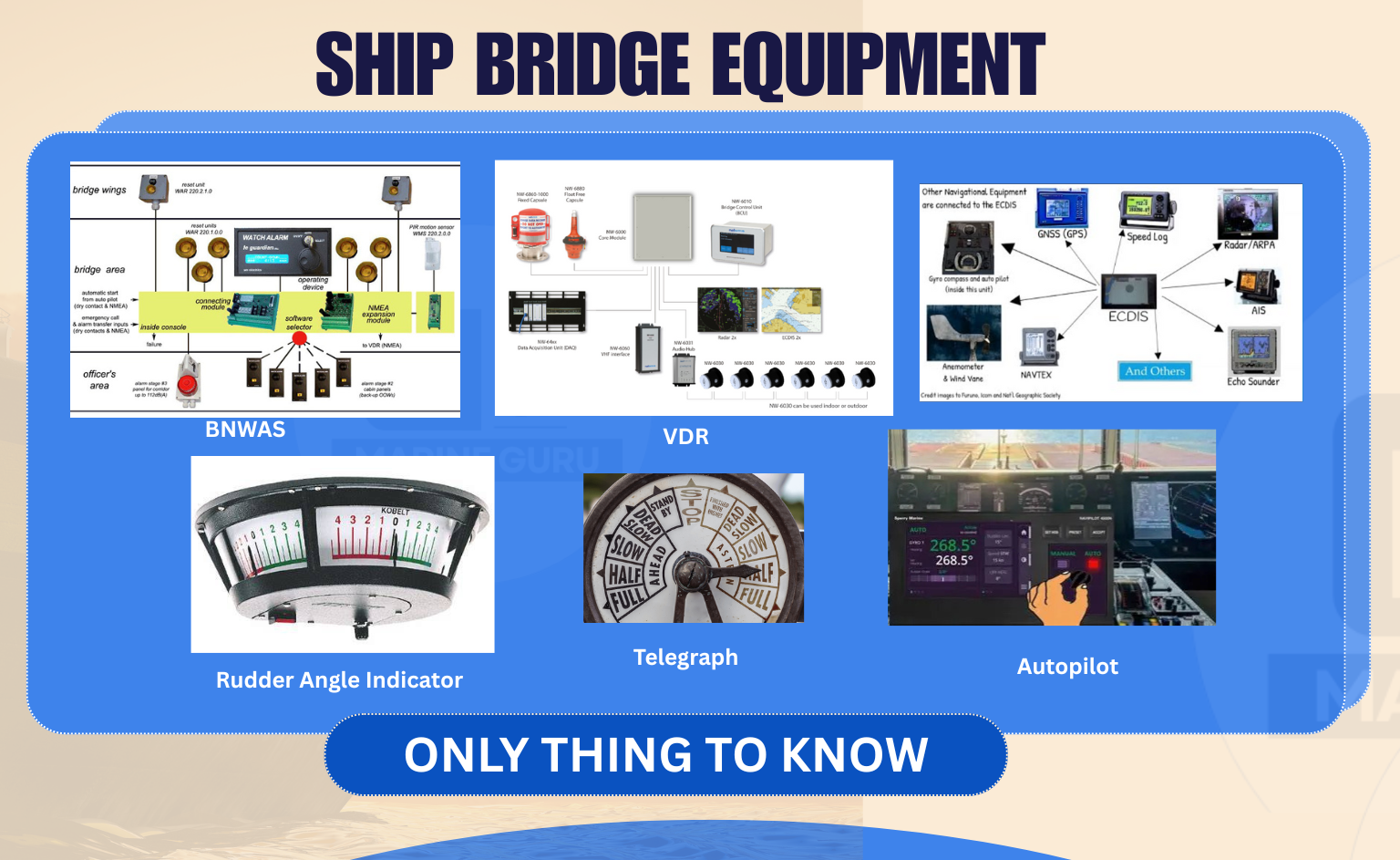
The bridge of a ship is its command center — the place where every decision about navigation, communication, and vessel control begins. Modern bridges combine advanced electronics with traditional instruments to ensure safe and efficient operation at sea.
Featured Snippet Answer (40–60 words)
A ship’s bridge contains navigation systems (like ECDIS, radar, GPS), communication and GMDSS equipment, vessel control systems (autopilot, propulsion controls, steering gear), monitoring devices (VDR, BNWAS), and safety/signaling tools. Together, these instruments allow officers to steer, navigate, communicate, and safely manage the ship.
1. Navigational Equipment on a Ship’s Bridge
These systems help you determine the ship’s position, speed, heading, and surrounding hazards.

Electronic Chart Display and Information System (ECDIS)
ECDIS replaces paper charts by displaying electronic navigational charts and integrating data from GPS, radar, AIS, and depth sounders. It improves route monitoring and reduces navigational errors.
GPS / GNSS Receiver
Provides accurate real-time position, course, and speed over ground, feeding critical data to ECDIS and conning displays.
Radar + ARPA
Radar detects ships, landmasses, and weather systems. ARPA automatically tracks targets, showing course, speed, and closest point of approach (CPA) so you can assess collision risks instantly.
Gyro Compass & Repeaters
A gyro compass provides a steady true-north heading. Repeaters display heading data throughout the bridge for easy reference.
Magnetic Compass
A mandatory backup providing direction based on Earth’s magnetic field — essential if electronic systems fail.
AIS (Automatic Identification System)
Transmits and receives identity, position, course, and speed data from nearby ships, improving situational awareness.
Echo Sounder
Uses sound waves to measure water depth below the keel, helping avoid grounding.
Speed Log
Measures speed through water and distance travelled — essential for navigation records.
Rate of Turn Indicator
Displays how quickly the ship is turning, aiding precise maneuvering during pilotage or narrow passages.
2. Communication & GMDSS Distress Equipment
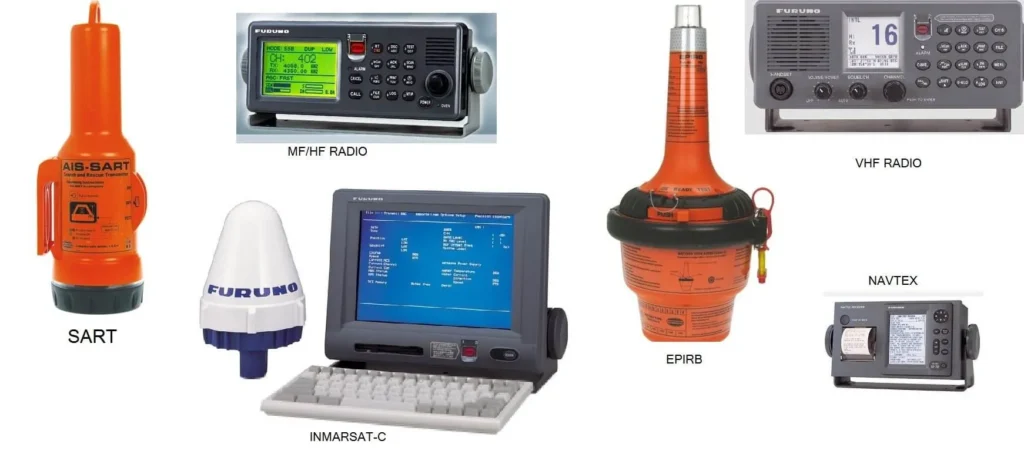
These systems ensure reliable communication and global emergency response capabilities.
VHF Radio
Used for short-range communication with ships, coastal stations, and pilots.
MF/HF Radio
Supports long-range communication and digital selective calling (DSC).
NAVTEX Receiver
Automatically receives navigation warnings, weather alerts, and safety information.
Satellite Communication (Inmarsat)
Enables global voice, data, and distress communication through GMDSS integration.
EPIRB
Automatically transmits the ship’s identity and position to search-and-rescue authorities during emergencies.
SART
Used in lifeboats; it helps rescue vessels locate survivors on radar.
3. Control & Monitoring Systems
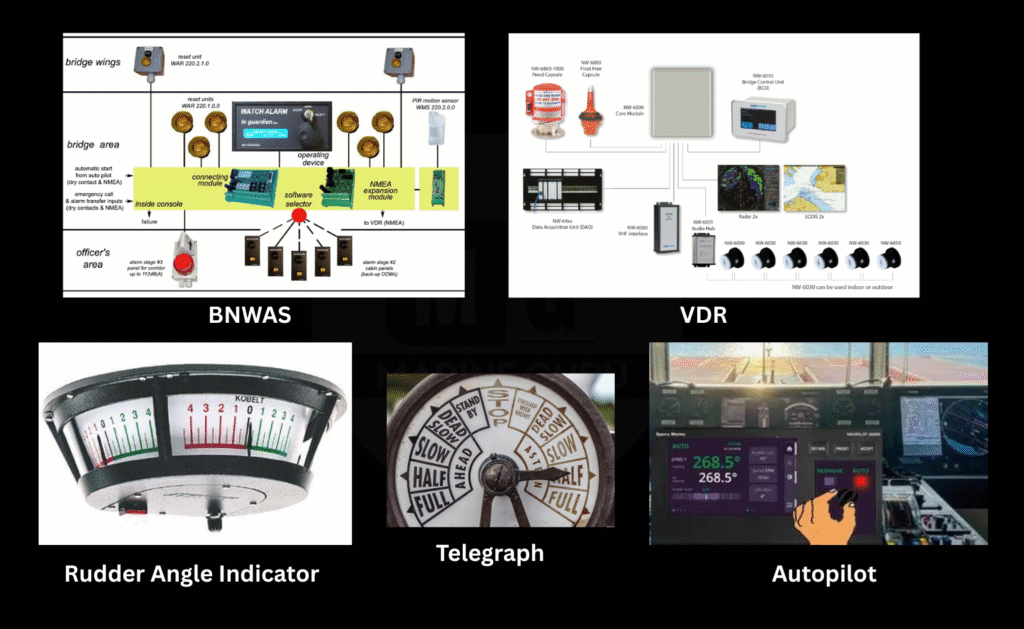
These systems help you steer the vessel and monitor essential operational data.
Autopilot System
Keeps the ship on a set course with minimal manual input, improving fuel efficiency and reducing crew workload.
Engine Order Telegraph / Propulsion Controls
Transmits speed and direction commands to the engine room or directly controls propulsion in electronically controlled ships.
Rudder Angle Indicator
Displays the exact position of the rudder so you can monitor steering responses.
Voyage Data Recorder (VDR)
The ship’s “black box,” continuously recording bridge audio, radar, position, and other critical data for investigation.
BNWAS (Watch Alarm System)
Ensures the officer on watch remains alert by issuing alarms after inactivity.
Sound Reception System
Allows officers inside enclosed bridges to hear external sound signals such as fog horns.
4. Safety & Signaling Equipment
Navigational Lights
Indicate the ship’s size, status, and direction during night or restricted visibility.
Ship Whistle / Fog Horn
Used for mandatory sound signals required by COLREGs.
Day Shapes
Black geometric shapes used during the day to display special vessel conditions like “anchored” or “restricted in ability to maneuver.”
Aldis Lamp
A handheld signaling lamp used for Morse-code communication.
5. Additional & Modern Bridge Systems
Integrated Bridge System (IBS)
Combines radar, ECDIS, conning, and automation displays into a centralized workstation for safer and more efficient operation.


Conning Display
Shows all essential navigation data — speed, heading, rudder angle, draft, RPM — in one place.
Barometer & Weather Instruments
Provides atmospheric pressure and weather trends critical for voyage planning.
CCTV Monitoring
Displays camera feeds from mooring decks, engine areas, and cargo spaces.
Pilot Plug
Allows harbor pilots to connect their portable navigation units.
6. Steering Gear Components (Bridge-Level Equipment)
| Component | Description | Function |
|---|---|---|
| Steering Wheel / Tiller | Manual steering device (wheel or joystick) | Directly controls rudder movement |
| Rudder Angle Indicator | Analog/digital display | Shows rudder position in degrees |
| Heading/Course Repeater | Gyro compass output | Shows current heading |
| Steering Mode Selector | Switch for Auto / Manual / FU / NFU modes | Determines steering control method |
| Autopilot Control Panel | Dedicated module for auto steering | Sets desired course |
| Engine/Propulsion Controls | Levers/joysticks | Control propeller speed and direction |