SART & AIS-SART: The Complete Guide for Seafarers (SOLAS/GMDSS)
TL;DR (30-second summary):


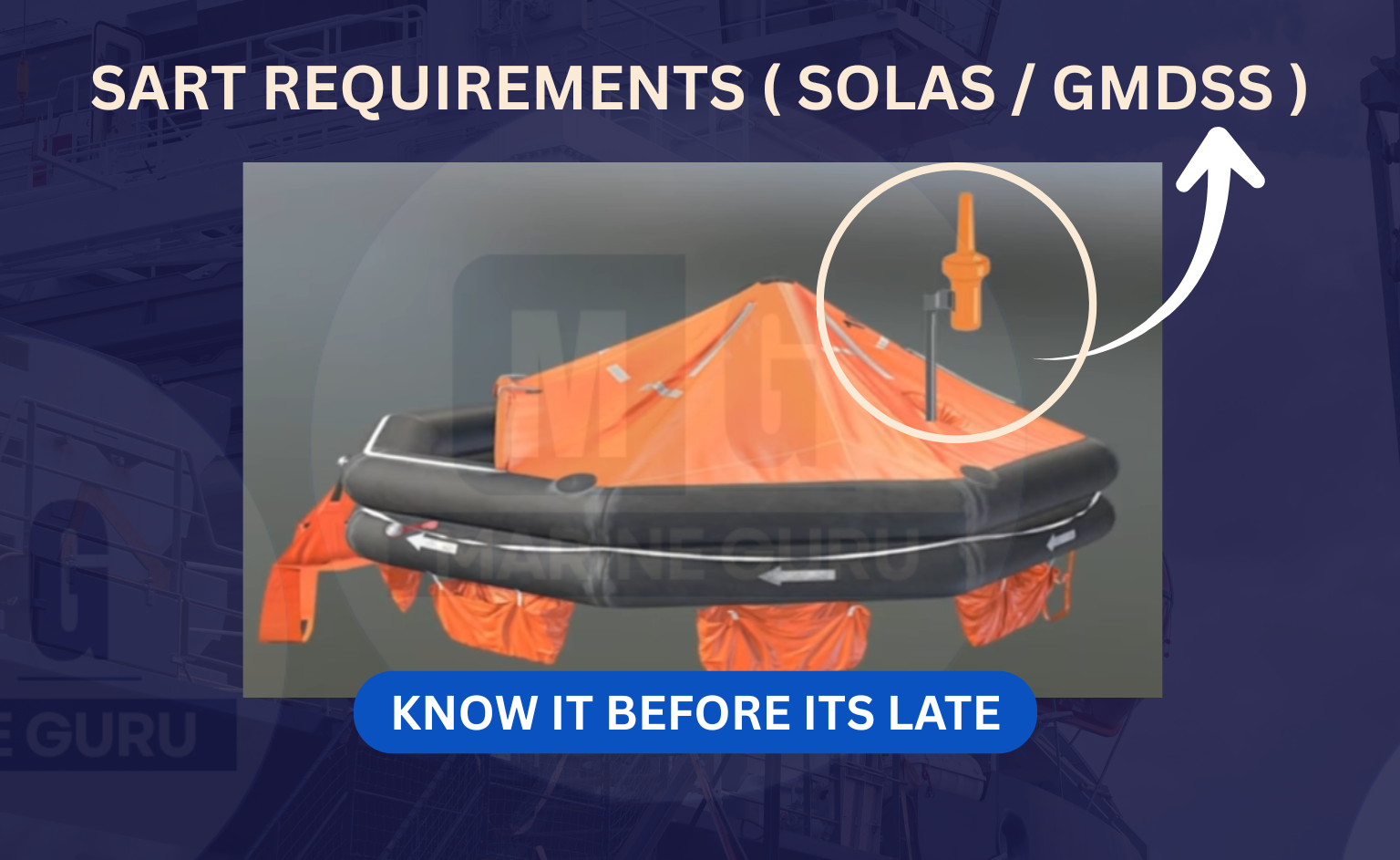
A SART (Search and Rescue Radar Transponder) replies to any X-band (9.2–9.5 GHz) radar with a distinctive line of 12–24 dots on the rescuer’s radar, precisely pointing to survivors. An AIS-SART broadcasts an AIS distress target (“SART ACTIVE”) with GPS position on AIS channels. Under SOLAS/GMDSS, cargo ships ≥300 GT must carry at least one SART/AIS-SART, and ≥500 GT must carry two. Height matters: raise the unit ≥1 m above water to extend detection range from a couple of miles to ~8–9 NM (helicopter: much farther).
1) What a SART actually does (and why EPIRB alone isn’t enough)
- EPIRB: Alerts satellites → shore MRCC → tasking of SAR units. Great for global alerting and coarse position.
- SART: Replies to nearby rescuers’ X-band radar with 12 dots spaced ~0.64 NM (and 24 when <1 NM due to “fast sweeps”). Great for final-mile localization in all weathers and at night.
- AIS-SART: Transmits its own AIS distress message (with GPS coordinates) on AIS Ch 1 & 2, painting a clear circular target with cross + “SART ACTIVE” on AIS displays.
Bottom line: EPIRB gets help coming; SART/AIS-SART gets help to you.
2) SOLAS/GMDSS carriage at a glance
| Ship Type & Size | Minimum Carriage | Notes |
|---|---|---|
| Cargo ships 300–<500 GT | 1 SART or AIS-SART | Mix permitted (e.g., choose AIS-SART). |
| Cargo ships ≥500 GT | 2 SARTs/AIS-SARTs | Any combination meeting minimum. |
| Passenger ships | 2 (typical) | Company/flag may require more near MES/rafts. |
| Liferaft/lifeboat stowage areas (remotely located)** | Extra units near embarkation as per arrangements | Ensures a device is available where you abandon ship. |
Practical best practice: keep one on bridge and one at survival-craft embarkation—both grab-and-go.

3) How the SART paints on radar (what you’ll actually see)
- Band: X-band radar only (9,200–9,500 MHz). S-band (~3 GHz) will not display SART replies.
- Pattern: 12 bright dots in a straight radial line, ~0.64 NM apart.
When the searching ship closes within ~1 NM, fast-sweep replies fill the gaps → 24 dots. - Interpretation tip: The first outer dot can lie ~0.64 NM beyond the true position when >1 NM away. Error shrinks to ~150 m as range closes.
- Side lobes: Near the target you may see rings/arcs—confirming strong return. Don’t filter them all out.
4) Range: why mounting height is everything
| Mounting / Situation | Typical Detection Range* |
|---|---|
| SART lying flat in raft | ~1.8 NM |
| SART upright inside raft | ~2.5 NM |
| SART floating alongside | ~~2 NM |
| SART ≥1 m above water (on mast/pole) | ~8–9 NM (shipborne X-band) |
| Helicopter/aircraft | ~25–30 NM (higher altitude = farther) |
*Actual range varies with antenna height, sea state, precipitation, radar power, and ducting.
Actionable rule: Mount it high and vertical (use the telescopic pole or boathook). Height buys miles.
5) On-scene radar settings that make the SART pop
Use X-band (mandatory for SART). Then:
- Range scale: 6–12 NM (the full SART line is ~9.5 NM long).
- Bandwidth: Medium/Wide (10–25 MHz). Avoid <5 MHz (can smear/hide dots).
- Gain: Set high (accept a little “snow”) to reveal weak dots.
- SEA clutter: Low (too much wipes out faint returns).
- RAIN clutter: Can remain on modestly; adjust as needed.
- Detune: Use briefly to cut storm noise, then return to normal—detune masks weak targets.
Start manual, then try auto only after you’ve positively identified the pattern.
6) SART quick-start in an abandon-ship scenario
- Grab the nearest SART/AIS-SART from its marked bracket (bridge / embarkation).
- Exit with lifejackets; board raft or survival craft.
- Mount the unit upright ≥1 m above sea level (raft mast/boathook/topping lift).
- Activate:
- SART—switch to ON; unit listens for X-band radar and replies automatically.
- AIS-SART—switch to ON/ARM; GPS acquires position (sends default until fixed), then broadcasts AIS MOB/SART on both channels.
- Secure the lanyard to the raft; keep vertical and clear of canopy/metal.
- Monitor: Keep a lookout; conserve batteries; be prepared to signal visually and audibly.
7) Battery life, environment & robustness (typical performance)
- Standby (SART listening): up to 96 h.
- Active replies: ≥8 h continuous.
- Operating temp: −20 °C to +55 °C; storage −30 °C to +65 °C.
- Immersion: 10 m / 5 min survivability.
- Drop: Endure 20 m drop (lifeboat release).
- Casing: High-viz yellow/orange, with clear pictogram instructions, mode LEDs, and battery expiry label.
- Floatability: If not hard-mounted, the unit floats and provides lanyards for securing.
Every crew member should practice donning during drills to ensure confidence during real emergencies.
8) SART vs AIS-SART vs EPIRB (quick comparison)
| Feature | SART | AIS-SART | EPIRB |
|---|---|---|---|
| How it’s detected | X-band radar replies (12–24 dots) | AIS distress target + GPS on AIS | Satellite (Cospas-Sarsat) |
| Position accuracy | Line-of-dots guides rescuers in | GPS coordinates broadcast | Satellite position via GNSS or Doppler |
| Range | ~8–9 NM from 1 m height (ship); 25–30 NM aircraft | ~5–9.5 NM from 1 m (ship AIS); 25–100+ NM aircraft AIS | Global alerting (not tactical approach) |
| Power profile | 96 h standby + ≥8 h active | Similar endurance (varies by model) | ~48 h transmission |
| Best use | Final-mile homing in all weathers | Final-mile + plotted GPS on AIS | Primary distress alerting |
Carry & use all three if available: they complement each other.
9) Installation, stowage & interference pitfalls
- Stow where you’ll grab it: bridge, ECR door, and near rafts/MES. Mark with retro-reflective signage.
- Keep clear of carbon-loaded canopies, metal frames, and close-by radar reflectors—they can shadow or distort replies.
- Height + verticality are king. Use raft mast/pole.
- Don’t bury in a locker behind non-essentials; this is grab gear.
10) Testing & maintenance (simple but critical)
- Weekly/Monthly visual: Seal intact, bracket secure, label legible, battery expiry in date.
- Functional test (per maker’s instructions):
- Press TEST; confirm LED/beep; some models allow radar test dots (briefly!) if an X-band is nearby.
- For AIS-SART: run TEST; verify a test AIS target (many models transmit special test messages that auto-expire).
- Batteries: Replace before expiry or after any real activation.
- Drills: Practice mounting fast and choosing radar settings; rehearse the grab-list.
Tip: Add SART/AIS-SART to your abandon-ship and raft-rigging checklists, and mark who carries which device.
11) Radar operator’s field guide (step-by-step)
- Confirm X-band is ON (don’t rely on S-band).
- Set 6–12 NM range; gain high; SEA low, RAIN modest; normal tune.
- Rotate range once you see the line: ensure entire ~9.5 NM dot string is visible.
- Home along the line towards the innermost dots (true location).
- Expect side lobes as you close; don’t over-filter.
- If no pattern: call survivors to raise SART; check your own antenna height and settings; try different ranges.
12) AIS-SART: what you’ll see and how to use it
- On AIS/ECDIS: a circle with a cross labeled “SART ACTIVE” (older units may show Unknown target with range/bearing).
- Fix time: sends a default until GPS locks (usually <60 s).
- Transmission: burst pattern on both AIS channels for reliability.
- Aircraft with AIS can receive at very long range (altitude dependent).
Best practice: Use both SART and AIS-SART where carried—maximizes detectability across assets.
13) Troubleshooting in the raft (fast fixes)
- Weak/No dots: Raise SART higher, ensure vertical, move away from metal or carbon canopy supports.
- Looks like clutter: Zoom to 6–12 NM, increase gain, reduce SEA. Dots are evenly spaced and linear—that’s your tell.
- Interference from radar reflector: Separate physically from SART. Don’t co-mount.
- Battery doubts: If expiry near or cold-soaked, warm inside clothing briefly, then remount.
14) Quick Questions
Q1. Does SOLAS allow AIS-SARTs instead of classic SARTs?
Yes. You can meet carriage with SARTs and/or AIS-SARTs in any combination that satisfies the minimum number required.
Q2. Which radar sees a SART—X-band or S-band?
Only X-band (9.2–9.5 GHz) shows the 12–24 dot pattern. S-band cannot detect SART replies.
Q3. What range should I expect from a raft?
With the SART ≥1 m above water, expect ~8–9 NM to a ship’s X-band radar. Helicopters can see much farther.
Q4. Where should I keep SARTs on board?
One on the bridge (ready rack) and one at survival-craft embarkation. Both locations clearly marked and unobstructed.
Q5. Can I test a SART without causing false alarms?
Yes—use the built-in TEST mode. Some units briefly generate a test indication only; follow the maker’s manual. For AIS-SART, most broadcast test messages that ECDIS/AIS recognize as tests.
Q6. Do waves hurt detection?
Paradoxically, raft motion often helps—the slight rocking clears multipath dead zones. Height remains the biggest factor.
Q7. Should I also rig a radar reflector?
Not next to a SART. Keep them separated; a reflector too close can shadow or confuse the SART return.
Q8. What about battery life once activated?
Plan for ≥8 h of active replies (after as much as ~96 h standby for SART). Conserve power but keep the unit on and elevated.
Rapid checklists (print-friendly)
Abandon-Ship: SART/AIS-SART grab-and-rig
- Take SART/AIS-SART from marked bracket (bridge/embarkation).
- Board raft; mount upright (≥1 m), secure lanyard.
- Switch ON/ARM (verify LEDs/sounds).
- Keep unit vertical & clear of canopy/metal.
- Maintain watch and conserve battery.
Bridge SAR Radar Setup (X-band)
- X-band ON; Range 6–12 NM.
- Gain high; SEA low; RAIN moderate.
- Bandwidth medium/wide (10–25 MHz).
- Avoid extended detune; use briefly only.
- Home on 12–24 dot line to inner end.
Monthly/Drill Maintenance
- Visual: seals, bracket, expiry, label, instructions.
- TEST function per manual (SART/AIS-SART).
- Verify crew know mounting points & radar settings.
- Log checks and replace battery before expiry.
16) Pro tips for Masters/2/O (exam & audit-ready)
- Mark SART/AIS-SART locations on the Fire Control & Safety Plan and the training manual.
- Include SART/AIS-SART in abandon-ship drill scripts (who grabs which device).
- Keep spare pole/mount in the raft pack or next to the bracket.
- Label with commission date, battery expiry, and a QR to the maker’s test procedure (if your company policy permits).
- Record functional checks and battery replacement in LSA records—auditors look for this.
FAQ
Q) What is a SART?
Ans: A Search and Rescue Radar Transponder that replies to X-band radar with a 12–24-dot line on the radar screen, guiding rescuers directly to survivors.
Q) What is an AIS-SART?
Ans: An AIS distress transponder that transmits GPS-positioned “SART ACTIVE” targets on AIS channels for rapid plotting on AIS/ECDIS.
Q) How many SARTs are required?
Ans: Cargo 300–<500 GT: 1; cargo ≥500 GT: 2; passenger ships typically 2 (flag/company may require more at MES/rafts).
Q) Which radar band sees a SART?
Ans: Only X-band (9.2–9.5 GHz).
Q) How far can a SART be detected?
Ans: From ≥1 m elevation: about 8–9 NM by ships; 25–30 NM (or more) by aircraft.
Life Saving Appliances (LSA) under 3rd Officer:
* Lifeboats (enclosed, rescue boats) and launching arrangements
* Liferafts and their hydrostatic release units
* Lifebuoys (with lights, smoke signals, and lifelines)
* Lifejackets (with lights and whistles) for all persons on board
* Immersion suits and thermal protective aids
* Emergency Position Indicating Radio Beacons (EPIRBs) and Search and Rescue Transponders (SARTs)
* Rocket parachute flares, hand flares, and buoyant smoke signals
* Line throwing appliances
* Muster list and SOLAS/LSA/Fire safety training manuals and posters
* Spare batteries, bulbs, and supporting inventory for LSA
Fire Fighting Appliances (FFA) under 3rd Officer
* Fire extinguishers (of all types) throughout accommodation and deck areas
* Fire hoses, hydrants, and nozzles
* Fireman’s outfits (protective clothing, boots, helmets, gloves)
* Self-contained breathing apparatus (SCBA) sets
* Fire blankets and sand buckets
* Fire alarms and detection systems
* Fire main and emergency fire pumps
* Fixed firefighting systems (CO2, foam, water mist, dry powder, etc.)
* Emergency escape breathing devices (EEBD)
* Portable and fixed communication equipment used in fire emergencies
Additional Responsibilities
* Keeping LSA/FFA inspection and maintenance records up to date (PMS)
* Training and familiarizing crew with the use of all equipment
* Ensuring LSA/FFA manuals, posters, and muster lists are current and correctly displayed
* Planning inventory needs and raising requisitions for expiring items/spares
* Reporting deficiencies and planning for shore-based inspections or servicing as required