
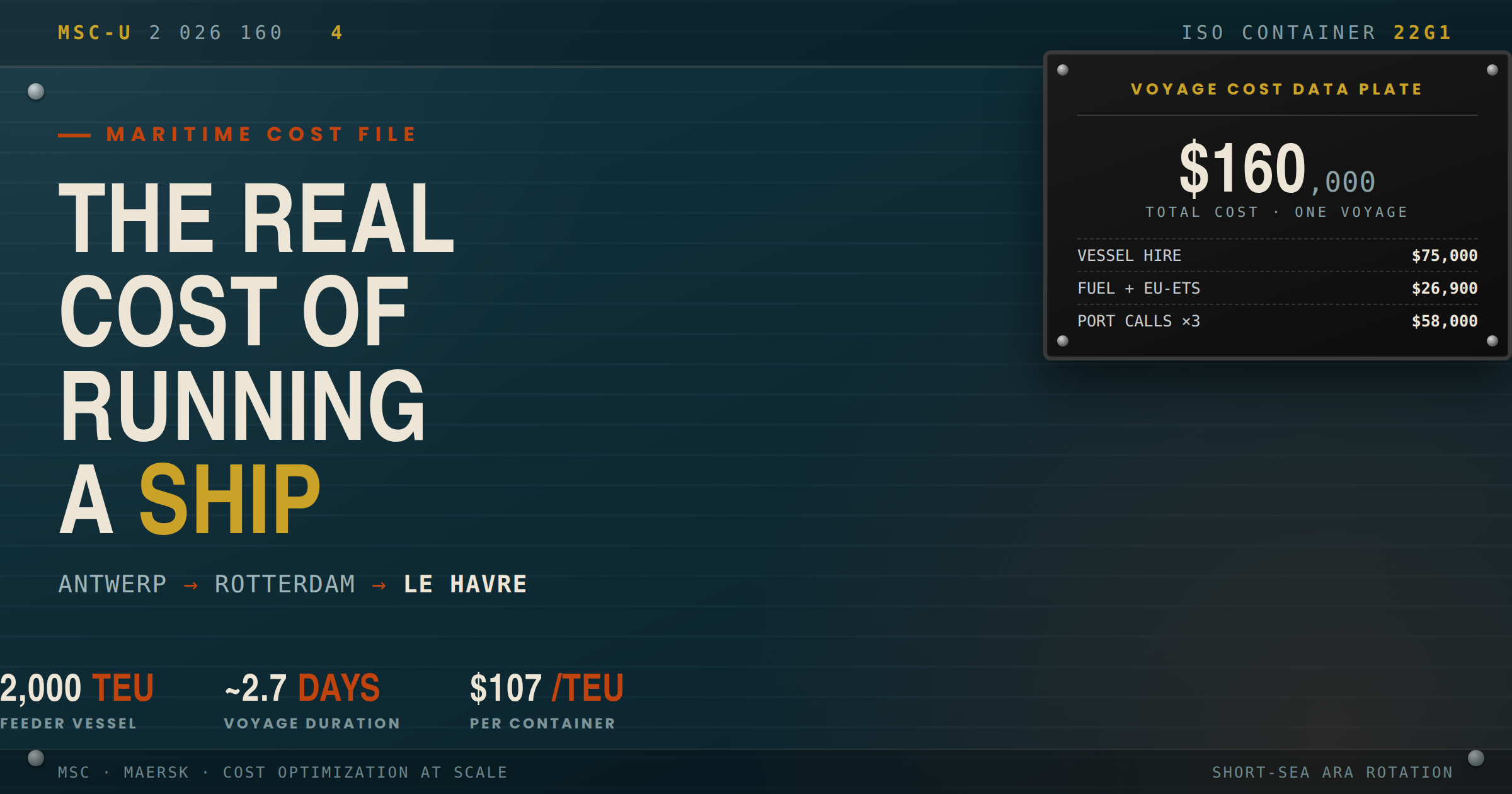
This estimate is a rough estimate and not exact figure, this can go beyond this based on different other factors as well.
This total cost of running a ship for one voyage calculation can at least give you a rough estimate based on which you can do other calculations.
Voyage Cost Analysis
Table of Contents
ToggleWhat does it actually cost
to run a ship for one voyage?
A worked cost breakdown for a 2,000 TEU feeder container ship on the Antwerp → Rotterdam → Le Havre short-sea rotation — vessel hire, fuel & EU-ETS carbon cost, and port charges — plus how Maersk and MSC structurally optimise these costs at scale.
The Rotation
AntwerpRotterdamLe Havreback to Antwerp~65 nm~230 nm~215 nm01
The Voyage Being Costed
A realistic base case: a 2,000 TEU feeder container ship running a closed loop — Antwerp → Rotterdam → Le Havre → back to Antwerp — a common ARA / short-sea rotation feeding deep-sea services and regional cargo.
| Leg | Distance | Time |
|---|---|---|
| Antwerp → Rotterdam | ~65 nm | — |
| Rotterdam → Le Havre | ~230 nm | — |
| Le Havre → Antwerp | ~215 nm | — |
| Total sailing distance | ~510 nm | ~32 hrs @ 16 kn |
| Port time (3 calls, combined) | — | ~30 hrs |
| Total voyage duration | — | ~2.5–3 days |
Rotation modeled as a closed short-sea loop returning to the origin port.
02
Cost Breakdown
Three line items make up the voyage: vessel hire, fuel plus carbon compliance, and port charges across three calls.
2.1 — Vessel Hire
Capital, crew, maintenance, and insurance, bundled into a single time-charter day-rate. Current broker benchmarks put daily charter rates for a 1,000 TEU ship at around $16,750/day (6–12 month deals), while one-year charters for 2,100 TEU non-eco feeders reached around $30,100/day as of December 2025. Interpolating for a 2,000 TEU geared feeder gives roughly $25,000/day.
| Item | Value |
|---|---|
| Daily charter rate (2,000 TEU feeder, interpolated) | $25,000/day |
| Voyage duration | 3 days |
2.2 — Fuel + EU-ETS Carbon Cost
EU-ETS compliance is expected to add $319.30 per tonne to VLSFO consumption in 2026, bringing the combined bunker-plus-carbon cost to $689.30/mt at Rotterdam — carbon compliance now costs nearly as much as the fuel itself. The scheme is fully phased in for 2026 (40% in 2024, 70% in 2025, 100% from 2026), so this is the permanent full rate for intra-EU voyages.
| Component | Consumption |
|---|---|
| At-sea (25 t/day × 1.3 days) | 32.5 t |
| In-port / auxiliary (5 t/day × 1.3 days) | 6.5 t |
| Total consumption | 39 t |
2.3 — Port Costs (×3 calls)
Each port charges roughly the same categories: port dues, pilotage, towage, berth/dockage, and agency fees. Rotterdam’s own tariff structure applies a base of roughly €0.50/GT for harbour dues, with pilotage set as a separate compulsory tariff. Figures below are per call, for a ~25,000 GT vessel (approx. 2,000 TEU).
| Item | Approx. cost / call |
|---|---|
| Port / harbour dues (~€0.50/GT base) | €10,000–12,500 |
| Pilotage (compulsory in/out) | €2,500–4,000 |
| Towage (tugs) | €1,500–3,000 |
| Agency fees | €1,500–2,500 |
Excludes Terminal Handling Charges (container lifts), which are billed to the cargo/shipper, not the vessel operator.
| Cost category | Amount (USD) |
|---|---|
| Vessel hire (3 days) | $75,000 |
| Fuel + EU-ETS | $26,900 |
| Port costs (3 calls) | $58,000 |
| TOTAL | ≈ $160,000 |
03
How Maersk & MSC Push This Cost Down
The line items above apply to any operator running this rotation. Scale changes what happens to each of them.
Economies of Scale
Port dues, pilotage, and fixed crew/capital costs barely rise with ship size, but TEU capacity does. Maersk’s scale and fuel efficiency gave it close to a 7% cost advantage over its nearest competitor on major routes — the same logic behind MSC’s rise to the largest fleet by capacity.
Slow Steaming
Fuel burn scales roughly with the cube of speed, so cutting speed even modestly cuts fuel disproportionately. Carriers manage excess supply through loop withdrawals, blank sailings, slow steaming, re-routing, and vessel swapping between ship sizes.
Alliances & Vessel-Sharing
Sharing ships and slots pools cost and cargo so no single line runs half-empty vessels. Since the 2M alliance dissolved, the market runs on Gemini (Maersk + Hapag-Lloyd), Ocean Alliance (CMA CGM, COSCO, OOCL, Evergreen), and Premier Alliance (ONE, HMM, Yang Ming), with MSC now operating independently at alliance-equivalent scale.
Charter / Owned Fleet Mix
Blending owned tonnage (fixed cost, no market exposure) with chartered-in ships (flexible, but rate-exposed) matches capacity to demand without overcommitting capital. 22 of the last 31 reported containership fixtures above 1,000 TEU ran longer than 22 months — a deliberate move to lock in tonnage rather than chase spot rates.
Owning Port Infrastructure
Both groups hold stakes in the terminals they call at — APM Terminals for Maersk, Terminal Investment Limited for MSC — converting a variable port cost into an internal transfer, a structural lever smaller operators don’t have.
Carbon-Cost Management
With EU-ETS now roughly matching bunker cost per tonne, carriers actively manage this line item through biofuel blending, route/speed optimisation, and newer dual-fuel LNG or methanol vessels.
Sources
The port-cost and fuel-consumption figures used to build the $160,000 total are representative estimates built from the tariff structures and industry benchmarks below — not a live tariff-calculator quote for this exact ship and sailing date.
Bunker Fuel & Carbon Costs
- Ship & Bunker — Analysis: Shipping’s Jump in EU-ETS Costs Will Offset Bunker-Price Decline in 2026 — shipandbunker.com
- Ship & Bunker — Global Average Bunker Price / methodology — shipandbunker.com
- Bunker Index — Rotterdam Bunker Prices — bunkerindex.com
- Ship & Bunker — Rotterdam Bunker Prices — shipandbunker.com
Charter / Time-Charter Rates
- MundoMaritimo — Containership charter market closes 2025 with solid rates — mundomaritimo.net
- Hansa News — Boxship charter rates better than pre-GFC boom years — hansa.news
- Container News — Long-term charters dominate latest reported containership fixtures — container-news.com
- Harper Petersen — HARPEX index methodology — harperpetersen.com
Port Costs (dues, pilotage, towage, agency)
- Port of Rotterdam — Port Dues Tariffs — portofrotterdam.com
- Port of Rotterdam — Seaport Dues — portofrotterdam.com
- Port of Rotterdam Local Charges tariff sheet (valid 1 July 2025) — weclines.com
- Nederlands Loodswezen — Pilotage Tariffs 2025 (Rotterdam-Rijnmond) — loodswezen.nl
- Ship Universe — The Top Overlooked Port Costs That Quietly Drain Profits — shipuniverse.com
- MaritimePage — Port Costs: A Guide To Port Dues And Fees For Cargo Ships — maritimepage.com
- Port Economics, Management and Policy — Ch. 9.4, Port Pricing — porteconomicsmanagement.org
- Medium (Shipping Intel) — Voyage Cost: Port Charges — medium.com
Maersk / MSC Strategy — Alliances, Scale, Slow Steaming
- Supply Chain Dive — MSC CEO says future deals with Maersk are possible despite 2M’s end — supplychaindive.com
- Ship Universe — Maersk and MSC End 2M Alliance, Reshaping Global Shipping Strategies — shipuniverse.com
- Lloyd’s List — 2M split driven by strategic differences between Maersk and MSC — lloydslist.com
- Tradlinx — Q3 2025 Scorecard: Maersk, MSC, CMA CGM, COSCO and Hapag-Lloyd — blogs.tradlinx.com
- A.P. Møller-Mærsk — Annual Report 2025 (investor relations) — investor.maersk.com
- S&P Global — Full Analysis: A.P. Moller-Maersk A/S, 4 Dec 2025 — investor.maersk.com
- CliffsNotes — Maersk Shipping Pricing Strategy: Challenges and Solutions — cliffsnotes.com
