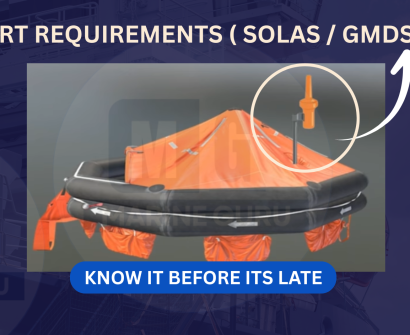
(SOLAS & LSA Code Requirements + How to Use Them)
When a ship, lifeboat, or life raft needs help, visual distress signals are used so rescuers can locate you quickly, even when radio communication fails.
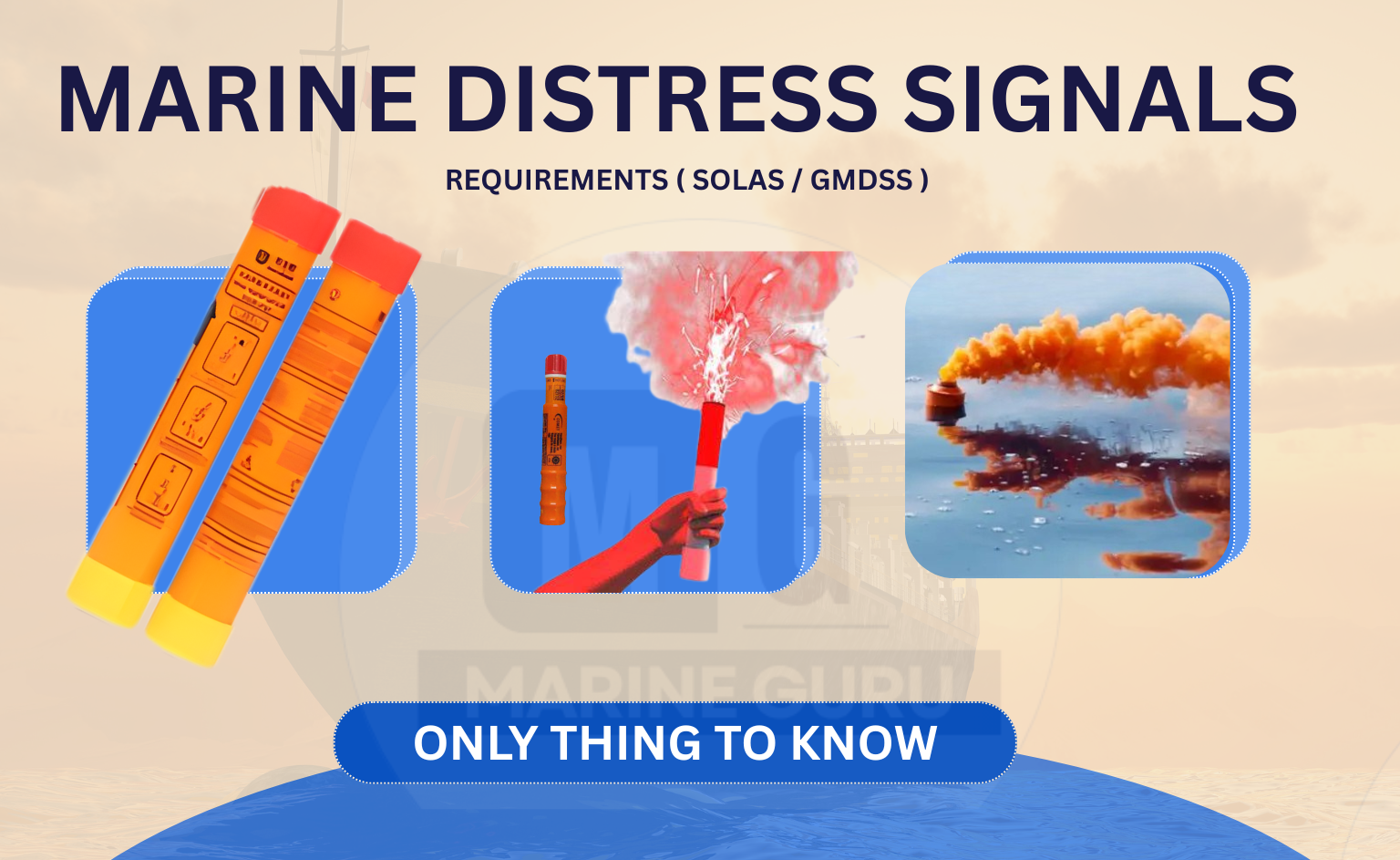
The three most common SOLAS-approved signals are:
✅ Rocket Parachute Flare
✅ Hand Flare
✅ Buoyant Smoke Signal
These are carried on all SOLAS-class ships, inside lifeboats and life rafts, and some are also kept on the bridge.
✅ Why do we carry visual Marine Distress Signals ?
When a ship, survival craft, or life raft needs immediate rescue, visual signals help:
- Alert nearby ships
- Attract aircraft and helicopters
- Show the exact position
- Communicate distress (even if radios or EPIRBs fail)
These signals save lives when electronic systems fail or visibility is low.
✅ Distress Signals Carriage Requirement (SOLAS)
SOLAS Chapter III Regulation 6:
All passenger and cargo ships must carry not less than 12 rocket parachute flares complying with LSA Code 3.1, stowed on or near the navigation bridge.
Additional hand flares and smoke signals are carried inside lifeboats and life rafts.

✅ 1. Rocket Parachute Flare (LSA Code 3.1)
A rocket parachute flare is used to attract help from long distances — especially ships and aircraft beyond the horizon.
✅ LSA Code Requirements
A rocket parachute flare must:
- Come in water-resistant casing
- Have printed instructions or diagrams
- Have built-in ignition
- Be designed so the holder feels no discomfort when fired
✅ Firing (Performance) Requirements
When launched vertically:
✔ Must reach 300 m or more
✔ At the top of trajectory, it releases a bright red parachute flare that:
- Has 30,000 candela minimum brightness
- Burns uniformly for at least 40 seconds
- Descends at ≤ 5 m/s
- Must not damage its parachute or cords
✅ When to use
- To signal long-range distress
- To attract attention of far-away ships or aircraft
- Best during night, clear weather, or long visibility
✅ How to use (Step-by-Step)
- Move to an open area, point flare straight up
- Hold firmly with two hands
- Remove safety pin / cap as instructed
- Aim vertically — never inclined toward ship or lifeboat
- Fire
✅ The parachute flare rises, slows down under parachute, and glows red for rescue teams to see.
✅ 2. Hand Flare (LSA Code 3.2)
A hand flare is used when the rescue unit is already nearby.
✅ LSA Code Requirements
Hand flare must:
- Have water-resistant casing
- Have printed instructions
- Have self-contained ignition
- Not burn the user or damage the survival craft
✅ Performance Requirements
✔ Bright red colour
✔ 15,000 candela or more
✔ Burns for minimum 1 minute
✔ Will still burn even after being immersed 10 seconds under 100 mm of water
✅ When to use
- When rescuers are within sight
- During final approach of a ship, rescue boat, or helicopter
- Day or night signaling
- To pinpoint exact position
✅ How to use
- Stand or kneel with wind behind you
- Hold flare outboard and downwind, away from your face
- Ignite using pull-cord / striker / twist cap
- Keep arm extended to avoid burns
- Never fire inside the lifeboat canopy
Tip: Hand flares drip molten residue — always hold over the sea, not inside the raft.
✅ 3. Buoyant Smoke Signal (LSA Code 3.3)
Used for daytime distress and marking your position to a ship or aircraft.
✅ LSA Code Requirements
Must:
- Be water-resistant
- Not ignite explosively
- Have printed instructions on casing
✅ Performance Requirements
✔ Emit high-visibility smoke
✔ Smoke must last at least 3 minutes
✔ Must not produce flame
✔ Must not swamp in waves
✔ Must continue smoking even after 10 seconds underwater at 100 mm depth
✅ When to use
- In daylight
- When a rescuing vessel or aircraft is nearby
- To mark your exact location in the water
- Excellent for helicopter approach guidance
✅ How to use
- Remove cap and activate pull-cord / striker
- Throw into the water, do NOT hold in hand
- Let it float and emit dense orange smoke
- The wind will carry smoke, making location visible
✅ Using Signals Together (Smart Sequence)
In real emergencies, professional rescuers expect this order:
| Situation | Best Signal |
|---|---|
| Very far ship or aircraft | Rocket Parachute Flare |
| Rescue close but searching | Hand Flare |
| Daytime, helicopter or ship nearby | Buoyant Smoke Signal |
| Night close-range | Hand flare |
| Confirm position while being seen | Smoke + Hand flare |
✅ Many lifeboats use all three together:
- Rocket gets attention
- Smoke guides rescuers
- Hand flare identifies exact pickup point
✅ Storage & Safety Tips
- Never fire under canopy
- Point away from your face and people
- Store in dry, marked containers
- Check expiry dates during monthly inspections
- Teach crew in abandon ship drills
✅ Quick exam / oral answers
Q: How far can rocket parachute flares be seen?
➡ Up to 40+ miles at night, depending on weather and height.
Q: Why hand flare if parachute flare was already used?
➡ Parachute flare attracts rescuers, hand flare guides final approach.
Q: Why is smoke signal used only in daytime?
➡ Because the signal is visible as coloured smoke, not light.
✅ Summary Table (LSA Requirements)
| Requirement | Rocket Parachute Flare | Hand Flare | Buoyant Smoke Signal |
|---|---|---|---|
| Colour | Red | Red | Orange smoke |
| Burn Time | ≥ 40 sec | ≥ 1 min | ≥ 3 min |
| Brightness | 30,000 cd | 15,000 cd | High-visibility smoke |
| Water Test | Parachute intact | Burns after 10 sec underwater | Works after 10 sec underwater |
| Usage | Long-range distress | Short-range visual confirmation | Daytime position marking |
| Hazard | Never point toward persons | Residue burns – keep outboard | Do not hold — throw into sea |
✅ In One Line
Rocket attracts rescuers, hand flare confirms location, smoke marks position for daytime pickup.
Life Saving Appliances (LSA) under 3rd Officer:
* Lifeboats (enclosed, rescue boats) and launching arrangements
* Liferafts and their hydrostatic release units
* Lifebuoys (with lights, smoke signals, and lifelines)
* Lifejackets (with lights and whistles) for all persons on board
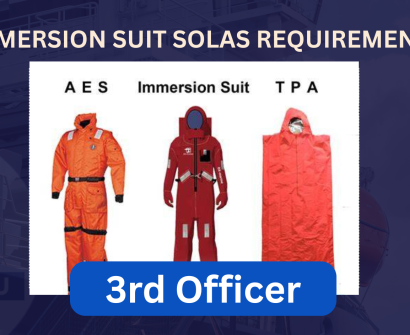
* Immersion suits and thermal protective aids
* Emergency Position Indicating Radio Beacons (EPIRBs) and Search and Rescue Transponders (SARTs)
* Rocket parachute flares, hand flares, and buoyant smoke signals
* Line throwing appliances
* Muster list and SOLAS/LSA/Fire safety training manuals and posters
* Spare batteries, bulbs, and supporting inventory for LSA
Fire Fighting Appliances (FFA) under 3rd Officer
* Fire extinguishers (of all types) throughout accommodation and deck areas
* Fire hoses, hydrants, and nozzles
* Fireman’s outfits (protective clothing, boots, helmets, gloves)
* Self-contained breathing apparatus (SCBA) sets
* Fire blankets and sand buckets
* Fire alarms and detection systems
* Fire main and emergency fire pumps
* Fixed firefighting systems (CO2, foam, water mist, dry powder, etc.)
* Emergency escape breathing devices (EEBD)
* Portable and fixed communication equipment used in fire emergencies
Additional Responsibilities
* Keeping LSA/FFA inspection and maintenance records up to date (PMS)
* Training and familiarizing crew with the use of all equipment
* Ensuring LSA/FFA manuals, posters, and muster lists are current and correctly displayed
* Planning inventory needs and raising requisitions for expiring items/spares
* Reporting deficiencies and planning for shore-based inspections or servicing as required